

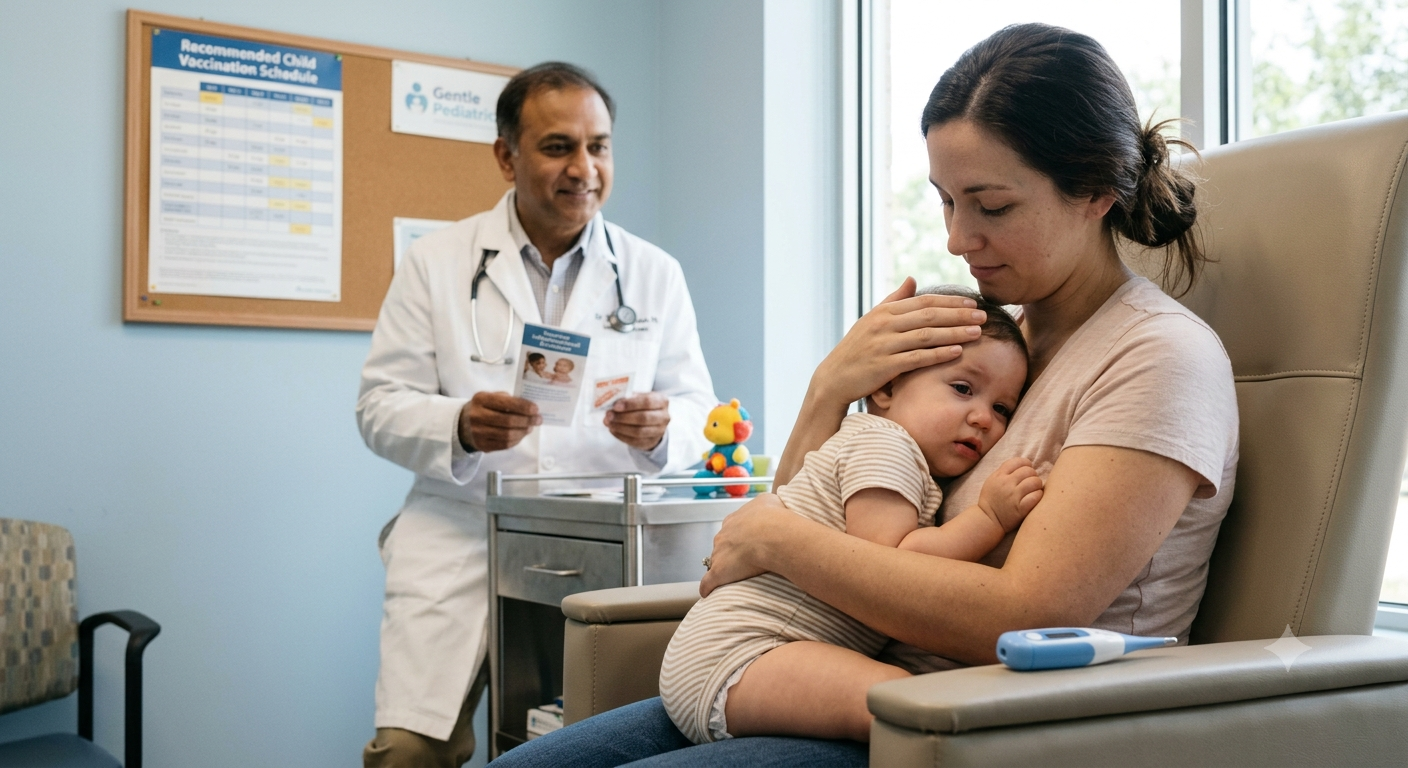
Quick Answer: A mild fever after vaccination is usually a normal sign that your child’s immune system is building protection and typically resolves within 24–48 hours. Keep your child comfortable with fluids, rest, and lightweight clothing, and monitor their symptoms. However, any fever of 100.4°F (38°C) or higher in an infant under 3 months requires immediate medical evaluation, even after vaccination. Contact your pediatrician if the fever persists, worsens, or is accompanied by concerning symptoms, and seek emergency care for signs of a severe allergic reaction.
As a parent, it’s natural to pay close attention to your child after they receive a vaccine. You may notice they’re sleepier than usual, a little fussy, or even develop a mild fever later that day.
One of the most common questions parents ask me is, “My child has a fever after their vaccination. Should I be worried?”
I understand why this can be concerning. The good news is that, in many cases, a mild fever after vaccination is a normal sign that your child’s immune system is responding as expected. However, age matters tremendously; a fever in a young infant under 3 months always requires immediate medical attention.
As a board-certified pediatrician with more than two decades of experience caring for infants, children, and adolescents, I have guided thousands of families through routine immunizations.
In this guide, I’ll explain why fever can occur after vaccination, how to care for your child at home, when to call your pediatrician, and why staying on your child’s vaccination schedule is one of the best ways to protect their long-term health.
Is a Fever After Vaccination Normal?
Yes, in many cases it is.
A mild fever after vaccination is a common and expected response. Vaccines work by helping the immune system recognize and fight harmful germs. As the immune system builds protection, it may produce a temporary fever.
This does not mean your child has the disease the vaccine is designed to prevent.
Instead, it usually means the immune system is responding appropriately.
Most post-vaccination fevers are:
- Mild
- Temporary
- Short-lived
- Not harmful
Many children continue eating, drinking, and playing normally despite a low-grade fever.
Why Do Vaccines Sometimes Cause Fever?
Vaccines teach the immune system how to recognize viruses or bacteria without causing the actual illness.
As the immune system responds, it releases natural chemicals that help build immunity.
This immune response may also cause temporary symptoms such as:
- Mild fever
- Soreness where the shot was given
- Redness or swelling at the injection site
- Fatigue
- Fussiness
- Mild loss of appetite
These symptoms usually improve on their own within one to two days.
Which Vaccines Are More Likely to Cause a Fever?
Several routine childhood vaccines can occasionally cause a mild fever.
Examples include:
- DTaP (Diphtheria, Tetanus, and Pertussis)
- Pneumococcal vaccine
- MMR (Measles, Mumps, and Rubella)
- Varicella (Chickenpox)
- Influenza vaccine
- COVID-19 vaccines when recommended for eligible children
The timing of a fever depends on the type of vaccine:
- Inactivated vaccines (like DTaP, Flu, and Pneumococcal): Fevers typically start within 24 hours of receiving the injection and last 24 to 48 hours.
- Live attenuated vaccines (like MMR and Varicella): Fevers often appear late, typically 7 to 12 days after vaccination, and may be accompanied by a temporary, mild rash as the live weakened virus replicates slightly to build long-term immunity.
What Temperature Is Considered a Fever?
A fever is medically defined as a body temperature of 100.4°F (38.0°C) or higher (measured rectally, which is the most accurate method for infants).
CRITICAL AGE EXCEPTION: In infants 3 months of age (90 days) or younger, ANY fever of 100.4°F (38.0°C) or higher is considered a medical emergency requiring immediate evaluation by a doctor to rule out serious bacterial infection, EVEN if they received their 2-month routine vaccines earlier that day. Never assume a fever in an infant under 3 months is solely a routine vaccine reaction without medical consultation.
For children over 3 months, how your child looks, breathes, and behaves is just as important as the number on the thermometer. A child with a mild fever who is drinking fluids, interacting normally, and resting comfortably is reassuring.
How Long Does the Fever Usually Last?
Most vaccine-related fevers:
- Begin within one to two days after vaccination
- Last less than 48 hours
- Improve without complications
If the fever lasts longer than expected or continues to worsen, your child should be evaluated by a healthcare provider.
How Can Parents Help at Home?
Most children recover with simple supportive care.
Here are several ways to help your child feel more comfortable.
1. Encourage Fluids
Offer plenty of fluids to help prevent dehydration.
Depending on your child’s age, this may include:
- Breast milk
- Formula
- Water
- Oral rehydration solutions if recommended
Older children should continue drinking regularly throughout the day.
2. Let Your Child Rest
The immune system works best when children get enough rest.
If your child wants to nap or take it easy for the day, that’s perfectly reasonable.
Most children return to their normal activity level quickly.
3. Dress Your Child Comfortably
Choose lightweight clothing rather than heavy blankets.
Keeping the room comfortably cool may also help your child feel better.
4. Watch the Injection Site
Some soreness or redness around the injection site is common.
A cool, clean compress may help reduce discomfort.
Avoid rubbing or massaging the area aggressively.
5. Safe Use of Fever-Reducing Medications
- Do NOT pre-medicate: Routine use of fever reducers before or immediately after vaccination is not recommended, as studies show it may slightly reduce the initial antibody response to certain vaccines.
- Acetaminophen (Tylenol): Can be used for pain or fever in infants over 2 months of age after consulting your pediatrician for correct weight-based dosing.
- Ibuprofen (Motrin/Advil): NEVER give ibuprofen to infants under 6 months of age unless specifically directed by your pediatrician. It is only approved for babies 6 months and older.
- NEVER give Aspirin: NEVER give aspirin to children or teenagers under any circumstances due to the risk of Reye’s Syndrome, a rare but life-threatening condition affecting the liver and brain.
What Symptoms Are Considered Normal?
After vaccination, many children experience mild reactions such as:
- Mild fever
- Sleepiness
- Fussiness
- Temporary decrease in appetite
- Mild redness at the injection site
- Mild swelling
- Tenderness where the vaccine was given
These reactions generally improve without treatment.
When Should Parents Call Their Pediatrician?
Although serious reactions are uncommon, parents should contact their healthcare provider if their child:
- Is under 3 months old with a temperature of 100.4°F (38.0°C) or higher
- Has a fever that lasts longer than two days
- Has a fever that returns after going away
- Refuses to drink fluids
- Has significantly fewer wet diapers
- Appears unusually sleepy or difficult to wake
- Cries inconsolably for several hours
- Has increasing redness or swelling at the injection site
- Has symptoms that continue to worsen instead of improving
Your pediatrician can determine whether the symptoms are related to the vaccine or another illness.
When Should You Seek Emergency Medical Care?
Rarely, children may develop a severe allergic reaction after vaccination.
Seek emergency medical care immediately if your child develops:
- Difficulty breathing
- Swelling of the lips, tongue, or throat
- Widespread hives
- Severe weakness
- Repeated vomiting
- Loss of consciousness
- Seizures
These symptoms require immediate medical evaluation.
Fortunately, severe allergic reactions to vaccines are very rare.
Vaccinations at Gentle Pediatrics
At Gentle Pediatrics, we believe vaccines are one of the most effective ways to protect children from preventable illnesses.
We provide:
- Routine childhood immunizations
- School-required vaccines
- Adolescent immunizations
- Vaccine counseling for parents
- Growth and developmental monitoring
- Wellness visits
- Personalized guidance based on the recommended child vaccination schedule
Families seeking pediatric vaccines in Sugar Land can count on our team to provide compassionate care while answering every question along the way.
Why Families Trust Gentle Pediatrics
Parents trust our practice because we believe informed families make confident healthcare decisions.
Our focus is on:
- Comprehensive pediatric care
- Evidence-based vaccine recommendations
- Personalized preventive care
- Family-centered communication
- Compassionate support
- Long-term health monitoring
Our goal is to help every child stay healthy through preventive care and timely immunizations.
About Dr. Shahid Hasnain
I am Dr. Shahid Hasnain, a board-certified pediatrician with more than two decades of experience caring for infants, children, and adolescents.
After earning a full scholarship to complete my Master of Public Health specializing in Maternal and Child Health in Birmingham, I completed my pediatric internship at Lincoln Hospital in New York and my residency at the University of Tennessee Medical Center in Knoxville, where I served as Chief Resident during my final year.
Since becoming Board Certified by the American Board of Pediatrics in 1998, I have remained committed to providing evidence-based, compassionate pediatric care with a gentle approach that helps families feel informed, reassured, and supported.
Final Thoughts
A mild fever after vaccination is usually a normal sign that your child’s immune system is responding to the vaccine and building protection against serious diseases.
Most fevers are temporary, resolve within a day or two, and can be managed with rest, fluids, and careful monitoring.
The most important thing is knowing when symptoms are expected and when they require medical attention.
By staying current with the recommended child vaccination schedule and partnering with your pediatrician, you can help protect your child from many preventable illnesses while giving them the healthiest possible start in life.
At Gentle Pediatrics, we are honored to support families through every stage of childhood with trusted preventive care and pediatric vaccines in Sugar Land.
Schedule a Pediatric Appointment
If your child has questions about vaccinations, develops a fever after immunization, or needs to stay on their recommended child vaccination schedule, our team is here to help.
Gentle Pediatrics proudly serves families throughout:
- Sugar Land
- Richmond
- Rosenberg
- Stafford
- Katy
- Houston
Contact our office today or fill out the online patient registration form to schedule an appointment and receive personalized care for your teen’s skin health and overall wellness.
Frequently Asked Questions
1. Is it normal for my child to have a fever after a vaccine?
Yes. A mild fever is a common and temporary response after many routine childhood vaccinations. It often means the immune system is building protection.
2. How long should a fever last after vaccination?
Most vaccine-related fevers begin within one or two days of vaccination and resolve within 24 to 48 hours. If the fever lasts longer or worsens, contact your pediatrician.
3. Should I give my child medicine before vaccines to prevent a fever?
Routine preventive use of fever-reducing medication before vaccination is generally not recommended unless advised by your healthcare provider. If your child develops discomfort afterward, ask your pediatrician about appropriate treatment.
4. When should I call the doctor about a fever after vaccination?
Contact your pediatrician if your child has a persistent or worsening fever, appears unusually sleepy, refuses fluids, develops increasing redness at the injection site, or has any symptoms that concern you.
5. Why is it important to follow the child vaccination schedule?
The recommended child vaccination schedule protects children against serious diseases at the ages when they are most vulnerable. Staying on schedule provides the best opportunity for safe and effective protection.
This article is intended for educational and informational purposes only and should not be considered medical advice, diagnosis, or treatment. Every child’s health needs are unique. Always consult your pediatrician or another qualified healthcare professional regarding concerns about your child’s fever, vaccinations, or overall health.