

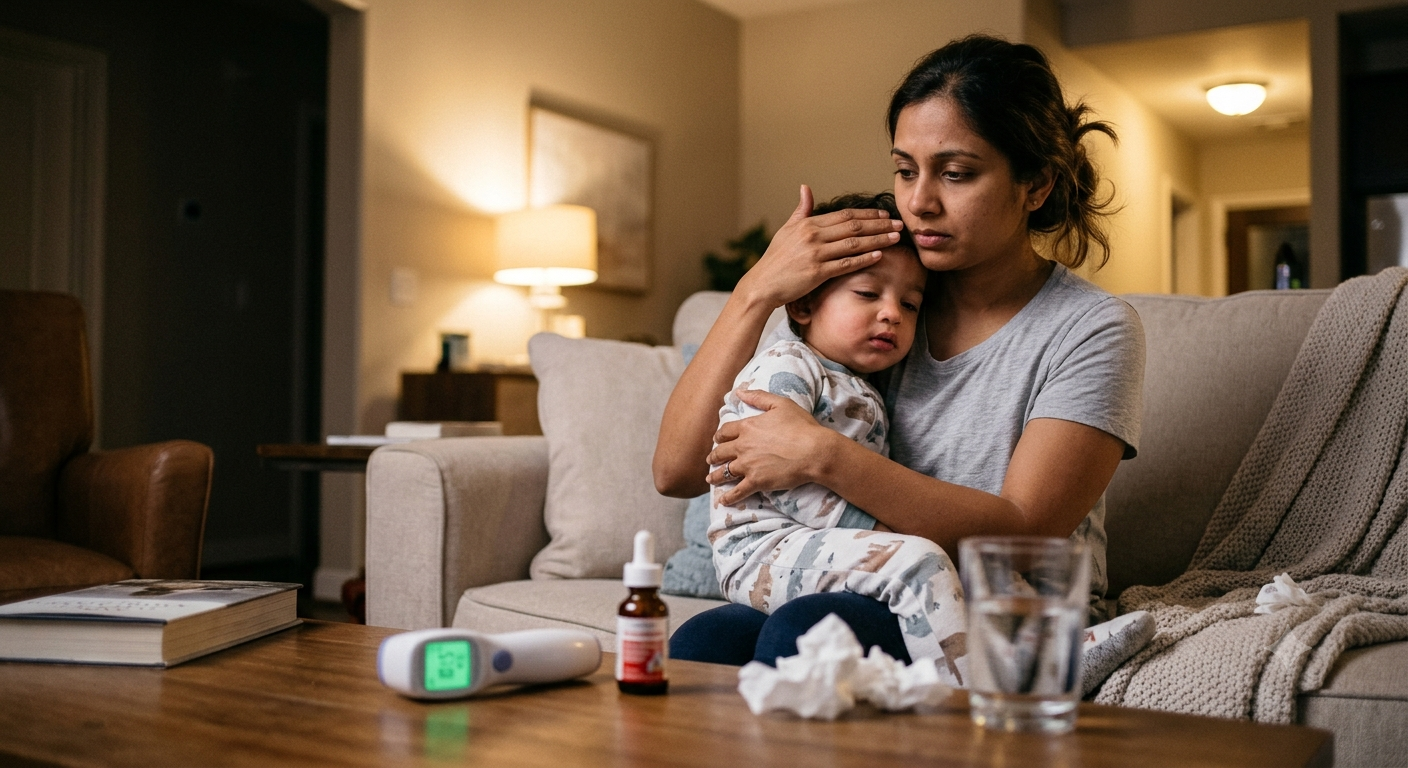
Quick Answer: Most childhood fevers can be managed at home with fluids, rest, and appropriate fever medicine. However, seek immediate medical evaluation if a baby younger than 3 months has a temperature of 100.4°F or higher. Take your child to the ER for difficulty breathing, seizures, unusual drowsiness, stiff neck, severe dehydration, or a non-fading rash. Contact your pediatrician if fever persists, symptoms worsen, or you are concerned about your child’s health.
A fever can be frightening when it happens to your child, especially at night or when your child is too young to explain how they feel. Many parents wonder whether they should wait, call their pediatrician, or head straight to the emergency room.
The most important thing to know is that a fever is a sign that the body is responding to an illness, not an illness itself. Many childhood fevers are caused by common infections and improve with time. However, a child’s age, behavior, breathing, hydration, and other symptoms matter more than the temperature alone.
As a board-certified pediatrician with more than two decades of experience caring for infants, children, and adolescents, I encourage parents to trust their instincts while also knowing which warning signs need immediate medical attention.
This guide explains when a fever needs emergency care, when to contact your pediatrician, and how to help your child feel more comfortable at home.
What Temperature Counts as a Fever?
A temperature of 100.4°F (38°C) or higher is generally considered a fever. The reading can vary depending on how you take your child’s temperature, so follow the thermometer instructions and tell your healthcare professional how you measured it.
The number on the thermometer is only one part of the picture. A child with a moderate fever who is alert, drinking fluids, and responding normally may be less concerning than a child with a lower temperature who is difficult to wake or struggling to breathe.
Look at your child’s overall condition. Are they making eye contact? Are they drinking? Are they breathing comfortably? These details help guide the next step.
When Should a Child With a Fever Go to the ER?
Some symptoms need emergency attention, regardless of the exact temperature.
Go to the emergency room or call 911 if your child:
- Has difficulty breathing, is gasping, or has blue or gray lips.
- Is difficult to wake, confused, unresponsive, or unusually weak.
- Has a seizure, especially a first seizure or one that lasts more than five minutes.
- Has a stiff neck with a severe headache or appears very ill.
- Develops a purple or red rash that does not fade when pressed.
- Shows signs of severe dehydration, such as very little urine, extreme sleepiness, or inability to drink.
- Has a fever after being left in a very hot environment or may have heatstroke.
These symptoms can point to a serious illness or emergency. Do not delay care to see whether fever medicine brings the temperature down.
If your child is having trouble breathing, is unresponsive, or is experiencing a prolonged seizure, call emergency services rather than trying to drive them yourself.
Fever in Babies: When Age Matters Most
A fever in a very young baby needs special attention.
If your baby is younger than 3 months and has a temperature of 100.4°F (38°C) or higher, seek immediate medical evaluation. Even if the baby looks comfortable or the fever is the only symptom, a healthcare professional needs to assess them. Do not give fever medicine before the baby is evaluated unless a clinician specifically instructs you to.
For babies between 3 and 6 months, contact your pediatrician promptly if the temperature reaches 102.2°F (39°C), or sooner if your baby looks unwell, is feeding poorly, or has other symptoms. Age-based guidance can vary, so when in doubt, call your child’s healthcare professional.
When Can You Call the Pediatrician Instead of Going to the ER?
Not every fever requires emergency care. If your child is alert, breathing comfortably, drinking fluids, and responding normally, you may be able to contact your pediatrician for guidance.
Call your child’s doctor if:
- Your child is getting worse or still seems very ill after the fever comes down.
- The fever lasts more than 24 hours in a child younger than 2 years.
- The fever lasts more than 3 days in a child 2 years or older.
- Your child has ear pain, a sore throat, a persistent cough, pain with urination, or repeated vomiting.
- Your child has a weakened immune system or a serious ongoing medical condition.
- You are worried and are unsure whether your child needs to be seen.
A pediatrician can help determine whether your child needs an examination, testing, or treatment. If emergency warning signs develop while you are waiting, seek emergency care.
How to Help Your Child Feel Better at Home
For children without emergency symptoms, the focus is comfort and hydration.
- Offer fluids often: Give water to older children and continue breast milk or formula for infants. If your child is vomiting or has diarrhea, ask your pediatrician whether an oral rehydration solution is appropriate.
- Let your child rest: Sleep and quiet activities can help your child recover. Check on them regularly, including overnight.
- Dress them comfortably: Use light clothing and avoid bundling them in heavy blankets. Do not use ice baths, cold baths, or rubbing alcohol to lower a fever.
- Use fever medicine carefully: Acetaminophen or ibuprofen may help if your child is uncomfortable, but the dose must be appropriate for the child’s age and weight. Ask your pediatrician or pharmacist if you are unsure. Do not give aspirin to children, and do not alternate or combine fever medicines unless a healthcare professional tells you to.
What Should Parents Do if a Fever Rises at Night?
If your child is breathing comfortably, responding normally, and able to drink fluids, you can often monitor them at home while watching for changes.
During nighttime fever:
- Check your child’s temperature with a digital thermometer.
- Offer water or breast milk and formula for infants, as appropriate.
- Keep clothing and bedding comfortable. Avoid heavy layers.
- Let your child rest, but check on them regularly during the night.
- Use fever medicine only if your child is uncomfortable and the medicine is suitable for their age and weight. Follow your pediatrician’s advice or the product instructions.
You do not need to wake a comfortable, sleeping child just to give fever medicine. However, check that your child is breathing normally and can be roused as expected. If your child is unusually difficult to wake, confused, struggling to breathe, or has a rash that does not fade when pressed, seek emergency care.
What Should Parents Know About Febrile Seizures?
Some children between about 6 months and 5 years can have a seizure during a fever. These are called febrile seizures. They can be frightening to witness, but many are brief and do not cause lasting harm. Still, a first seizure needs urgent medical assessment.
If your child has a seizure:
- Place them on their side on a safe surface.
- Move nearby objects away to prevent injury.
- Do not hold them down or put anything in their mouth.
- Note how long the seizure lasts.
- Call emergency services if it lasts more than five minutes, your child has trouble breathing, or they do not regain normal responsiveness.
Do not try to give oral medicine or fluids during a seizure.
Child Fever Treatment at Gentle Pediatrics
At Gentle Pediatrics, we understand how stressful it can be when your child is sick. Our approach to child fever treatment in Sugar Land focuses on assessing symptoms, identifying possible causes, and helping parents understand the safest next steps.
A pediatric visit may include checking your child’s temperature, hydration, breathing, and other symptoms. Depending on the findings, the doctor may recommend home care, testing, treatment, or referral for urgent evaluation.
About Dr. Shahid Hasnain
I am a board-certified pediatrician with more than two decades of experience caring for infants, children, and adolescents. I have been board-certified by the American Board of Pediatrics since 1998.
My training includes a Master’s in Public Health specializing in Maternal & Child Health, a pediatric internship at Lincoln Hospital in New York, and residency at the University of Tennessee Medical Center in Knoxville, where I served as Chief Resident in my final year.
At Gentle Pediatrics, I combine clinical experience with a gentle approach and clear communication to help families make informed decisions about their children’s health.
Final Thoughts
Most childhood fevers are caused by common infections and can be managed with careful observation, fluids, rest, and comfort measures. However, a fever in a baby younger than 3 months, difficulty breathing, a seizure, unusual confusion or sleepiness, a stiff neck, or a rash that does not fade with pressure needs urgent medical attention. The child’s behavior and other symptoms matter just as much as the temperature.
At Gentle Pediatrics, I encourage parents to trust their instincts and seek guidance when they are concerned. If your child needs assessment for a fever, our team can help you understand the next steps and discuss appropriate child fever treatment in Sugar Land.
Schedule a Pediatric Visit
If your child has a fever and you are unsure about the next step, our team at Gentle Pediatrics is here to help.
Gentle Pediatrics proudly serves families throughout:
- Sugar Land
- Richmond
- Rosenberg
- Stafford
- Katy
- Houston
📍 Gentle Pediatrics, Sugar Land, Texas
Contact our office today or fill out the online patient registration form to discuss your child’s fever, symptoms, and overall health with a trusted pediatrician. If your child has emergency warning signs, seek emergency care rather than waiting for an appointment.
Frequently Asked Questions
1. Does every high fever mean my child needs the ER?
No. The child’s age, behavior, breathing, hydration, and other symptoms matter. However, a fever with emergency warning signs needs immediate care.
2. Should I take my baby to the ER for a temperature of 100.4°F?
If your baby is younger than 3 months, a temperature of 100.4°F (38°C) or higher needs immediate medical evaluation.
3. What if my child’s fever reaches 104°F?
A fever that repeatedly rises above 104°F (40°C) is a reason to contact your child’s doctor promptly. Seek emergency care if the child also has serious symptoms or looks very ill.
4. Can I give my child fever medicine?
Acetaminophen or ibuprofen may help with discomfort when appropriate for your child’s age and weight. Follow professional guidance and never give aspirin to children.
5. How long can a fever last before I call the doctor?
Contact your pediatrician if fever lasts more than 24 hours in a child younger than 2 years or more than 3 days in a child 2 years or older. Seek care sooner if symptoms worsen or you are concerned.
This article is for general educational purposes and does not replace professional medical advice, diagnosis, or treatment. Fever can sometimes signal a serious illness, especially in young infants. Seek immediate medical evaluation for a baby younger than 3 months with a temperature of 100.4°F (38°C) or higher, and seek emergency care for serious symptoms.