

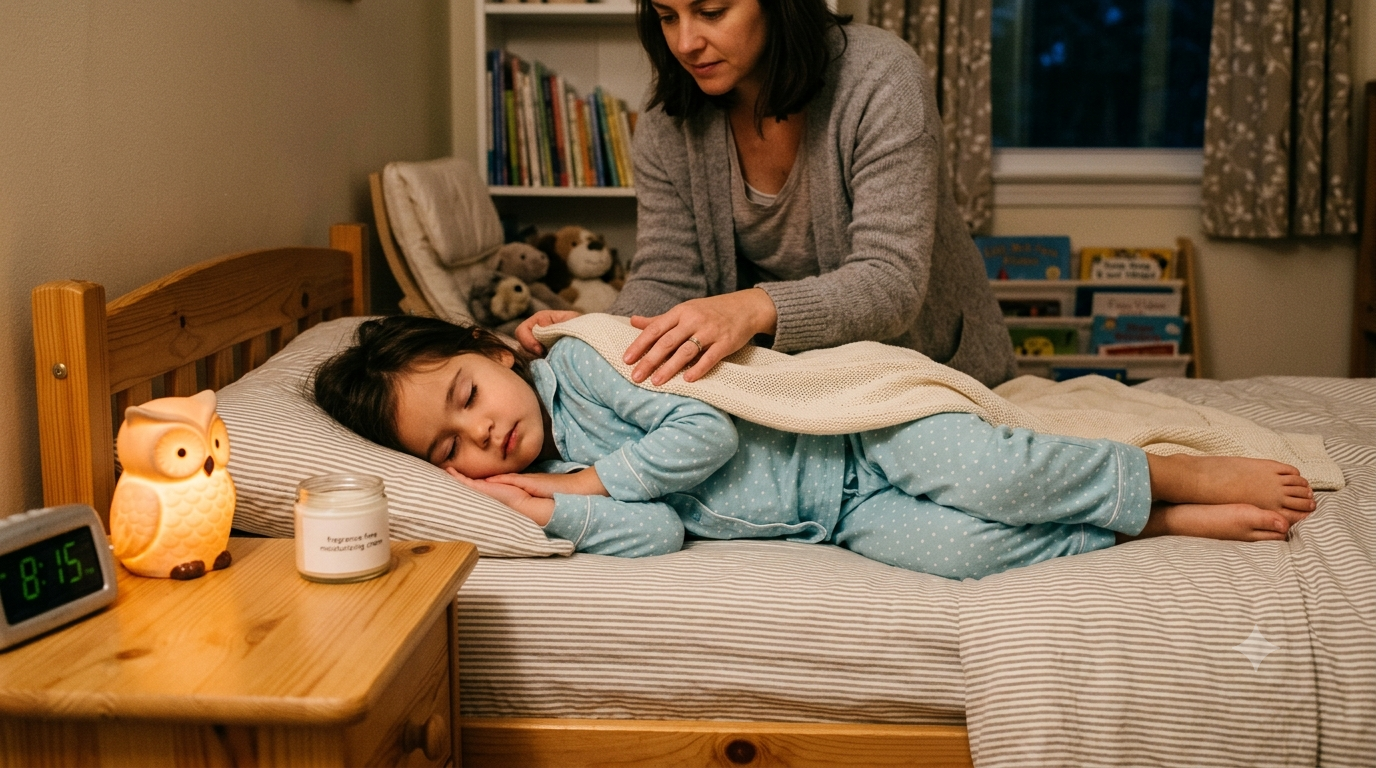
Quick Answer: Nighttime itching in children can result from dry skin, eczema, contact dermatitis, insect bites, allergies, or scabies. Heat, sweating, dry air, and irritating products may make itching worse at bedtime. Parents can help with short lukewarm baths, fragrance-free products, regular moisturizing, cool sleepwear, and short fingernails. If itching persists, disrupts sleep, causes sores, spreads, or affects other family members, consult a pediatrician to identify the cause and provide appropriate treatment.
Seeing your child wake up repeatedly at night because their skin is itchy can be frustrating and concerning.
Parents often notice that their child seems comfortable during the day but starts scratching intensely after going to bed. Sometimes the cause is simple dry skin. In other cases, nighttime itching may be related to eczema, an irritation or allergic reaction, insect bites, or a contagious skin condition such as scabies.
The important thing is not to assume that every itchy rash has the same cause.
As a board-certified pediatrician with more than two decades of experience caring for infants, children, and adolescents, I encourage parents to look at the pattern of itching, examine the skin carefully, and seek medical guidance when symptoms persist or interfere with sleep.
This guide explains some common reasons children scratch at night and what parents can safely do.
Why Does Itching Get Worse at Night?
Itching can seem more noticeable at bedtime for several reasons.
During the day, children are distracted by school, play, activities, and other things around them. At night, there are fewer distractions, so they may become more aware of skin discomfort.
Heat and sweating can also worsen itching in some children, particularly those with eczema. The American Academy of Dermatology notes that overheating and sweat can trigger eczema flare-ups.
Dry air, irritating clothing, fragranced products, and certain detergents may also contribute to skin irritation.
However, intense nighttime itching has another important possible cause: scabies.
That is why the location and appearance of the rash matter.
Common Causes of Nighttime Itching in Children
Several conditions can cause children to scratch their skin at night.
Common possibilities include:
- Dry skin
- Eczema
- Contact dermatitis
- Insect bites
- Scabies
- Allergic reactions
- Skin infections
- Irritation from soaps, detergents, or fabrics
The same symptom can have very different causes.
For this reason, I do not recommend treating every itchy rash with the same medication.
Eczema Is a Common Cause
Eczema, also called atopic dermatitis, is one of the most common causes of chronic itchy skin in children.
It often causes areas of dry, itchy, irritated skin. Children may scratch until the skin becomes raw or develops small cracks.
The American Academy of Pediatrics explains that eczema can make it difficult for children to sleep, while scratching can increase the risk of skin infection.
Eczema often begins during early childhood, although it can also develop later.
Parents may notice:
- Dry or rough skin
- Itchy patches
- Recurrent rashes
- Red, brown, purple, or gray areas depending on skin tone
- Cracked skin
- Scratching that becomes worse at night
Eczema is not contagious.
Treatment focuses on protecting the skin barrier, reducing inflammation and itching, and identifying triggers.
Could Dry Skin Be the Problem?
Sometimes the explanation is much simpler.
Dry skin can become itchy, particularly when children take long, hot baths or showers or when the air is dry.
Certain soaps, bubble baths, fragrances, and detergents may also irritate sensitive skin.
If your child’s skin looks dry or flaky without a significant rash, improving the skin-care routine may help.
The American Academy of Dermatology recommends short baths with warm rather than hot water, mild fragrance-free cleansers when needed, and regular use of thick creams or ointments to moisturize the skin.
Could Something Be Irritating Your Child’s Skin?
Contact dermatitis occurs when the skin reacts to something that touches it.
Possible irritants include:
- Fragranced soaps
- Laundry detergents
- Fabric softeners
- New clothing
- Lotions
- Personal-care products
- Certain fabrics
- Adhesives
If the rash appears mainly where something touches the skin, contact irritation may be worth considering.
For example, a rash around the waist could potentially be related to clothing or detergent, while irritation around the neck may have another cause.
Keeping a simple record of when the rash appears and what your child has been exposed to can be helpful when speaking with a healthcare provider.
Could It Be Scabies?
One important cause of nighttime itching is scabies.
Scabies is caused by a microscopic mite that burrows into the upper layer of the skin. The CDC identifies intense itching, especially at night, and a pimple-like rash as common symptoms.
In older children, scabies commonly affects areas such as:
- Between the fingers
- Wrists
- Elbows
- Armpits
- Waist
- Buttocks
- Groin
In infants and very young children, the rash can also involve the head, face, neck, palms, and soles.
Scabies can spread through prolonged, direct skin-to-skin contact.
If one family member has intense nighttime itching, particularly if other household members have developed similar symptoms, talk with a healthcare professional.
Scabies requires specific treatment. Simply applying a moisturizer or ordinary anti-itch cream will not eliminate the infestation.
What Does Scratching Do to the Skin?
Scratching may provide temporary relief, but it can create a cycle that makes the problem worse.
When children repeatedly scratch, they can damage the skin’s protective barrier.
This may lead to:
- Cuts
- Bleeding
- Crusting
- Increased irritation
- Skin thickening
- Bacterial infection
The American Academy of Dermatology notes that repeated scratching can cause sores and increase the risk of infection, particularly with conditions such as scabies and eczema.
This is one reason controlling the underlying itch is more important than simply telling a child to stop scratching.
How Can Parents Help at Home?
If your child’s itching appears mild and there are no concerning symptoms, several skin-care measures may help.
1. Keep Baths Short and Lukewarm
Use warm rather than hot water.
Long, hot baths can dry the skin and may worsen irritation.
For children with eczema, the AAD recommends limiting bathing time and using mild, fragrance-free cleansers when needed.
2. Moisturize Regularly
Apply a thick, fragrance-free cream or ointment after bathing.
Moisturizing helps support the skin barrier and can reduce dryness.
For children with eczema, regular moisturizing is an important part of everyday skin care.
3. Keep Your Child Cool at Night
Overheating and sweating can aggravate eczema and itching in some children.
Use comfortable, loose-fitting sleepwear and avoid excessive blankets.
The goal is to keep your child comfortable without allowing them to become hot and sweaty.
4. Keep Fingernails Short
Trim your child’s fingernails regularly and keep them smooth.
This can reduce the amount of damage caused by scratching.
For children who scratch during sleep, parents may discuss age-appropriate protective measures with their healthcare provider. The AAD notes that keeping nails short and smooth can reduce the likelihood of scratching breaking the skin.
5. Avoid Strong Fragrances
Consider using fragrance-free products for:
- Soap
- Moisturizer
- Laundry detergent
- Fabric softener
If you suspect a particular product is causing irritation, stop using it and see whether the skin improves.
Should I Give My Child an Anti-Itch Medicine?
Parents sometimes reach for an over-the-counter antihistamine or topical medication when their child is scratching.
However, I recommend speaking with your child’s healthcare provider before giving medication, especially to younger children.
The correct treatment depends on the cause.
For example, eczema may require a specific skin-care plan and sometimes prescription treatment. Scabies requires treatment directed at the mite. An allergic reaction may require a different approach.
Using the wrong product can delay appropriate treatment or irritate already sensitive skin.
When Should I Take My Child to a Doctor?
Make an appointment if your child’s itching:
- Happens frequently
- Interferes with sleep
- Keeps returning
- Is associated with a persistent rash
- Causes bleeding or open sores
- Is spreading
- Does not improve with basic skin care
- Affects multiple family members
- Is accompanied by other symptoms
A pediatrician can examine the skin and determine whether your child may need treatment, testing, or referral to a dermatologist.
As a kids’ doctor in Sugar Land, I encourage parents to bring in persistent skin concerns rather than repeatedly trying different products at home.
Watch for Signs of Skin Infection
Repeated scratching can damage the skin and create an opening for bacteria.
Contact your child’s healthcare provider if you notice:
- Increasing redness
- Warmth or swelling
- Pus or drainage
- Yellow crusting
- Increasing pain
- Red streaks
- Fever
A spreading red area, especially when accompanied by fever or a child who looks or acts very sick, requires prompt medical attention.
A Real Experience From My Practice
Over the years, I have cared for many children whose parents initially came in because their child simply could not stop scratching.
One pattern I often see is that parents have already tried several soaps, creams, or home remedies without knowing what is actually causing the itching.
The important first step is identifying the pattern.
I ask parents when the itching occurs, whether it is worse at night, where the child scratches, whether there is a visible rash, whether anyone else in the household is itchy, and whether the child has a history of eczema or allergies.
These details can help narrow down the possible causes.
Sometimes, the solution is improving the child’s skin-care routine. In other situations, the examination may suggest a condition that requires specific medical treatment.
The goal is not simply to stop the scratching for one night.
It is to understand why the skin is itching in the first place.
Why Does Treating the Cause Matter?
Itching is a symptom, not a diagnosis.
Two children can both scratch their arms at night but have completely different conditions.
One may have dry skin.
Another may have eczema.
Another may have contact dermatitis.
A child with intense nighttime itching and a characteristic rash could have scabies.
These conditions require different approaches.
That is why a proper examination is important when symptoms persist.
Pediatric Skin Care at Gentle Pediatrics
At Gentle Pediatrics, we understand how stressful persistent itching can be for both children and parents.
Our goal is to identify the underlying concern and provide practical guidance that families can follow at home.
We can evaluate concerns such as:
- Eczema
- Dry skin
- Rashes
- Allergic skin reactions
- Possible infections
- Persistent itching
- Skin irritation
As a trusted kids’ doctor in Sugar Land, I believe parents should receive clear explanations about what may be causing their child’s symptoms and what steps to take next.
About Dr. Shahid Hasnain
I am Dr. Shahid Hasnain, a board-certified pediatrician with more than two decades of experience caring for infants, children, and adolescents.
I earned a full scholarship to complete my Master of Public Health, specializing in Maternal and Child Health, in Birmingham.
I completed my pediatric internship at Lincoln Hospital in New York and my residency at the University of Tennessee Medical Center in Knoxville, where I served as Chief Resident during my final year.
I have been Board Certified by the American Board of Pediatrics since 1998.
Throughout my career, I have remained committed to evidence-based medicine and compassionate pediatric care. I believe that good communication is an important part of helping families make informed decisions about their children’s health.
Final Thoughts
If your child keeps scratching their skin at night, there may be a simple explanation, but persistent nighttime itching deserves attention.
Dry skin, eczema, contact dermatitis, and scabies are among the possible causes.
Start with gentle skin care, avoid obvious irritants, keep your child’s skin moisturized, and try to prevent overheating at night.
Most importantly, do not ignore itching that continues, interferes with sleep, causes skin damage, or affects other members of the household.
A pediatrician can examine your child’s skin and help determine the appropriate next step.
At Gentle Pediatrics, we are here to help families understand their child’s symptoms and provide thoughtful care from infancy through adolescence.
Schedule a Pediatric Appointment
If your child is waking at night because of persistent itching, our team can help evaluate the concern.
Gentle Pediatrics proudly serves families throughout:
- Sugar Land
- Richmond
- Rosenberg
- Stafford
- Katy
- Houston
Contact our office today or fill out the online patient registration form to schedule an appointment with a trusted kids’ doctor in Sugar Land and discuss your child’s persistent itching or skin concerns.
Frequently Asked Questions
1. Why does my child scratch more at night?
Nighttime scratching can occur with eczema, dry skin, irritation, or scabies. Heat, sweating, and fewer daytime distractions may also make itching feel more noticeable at night.
2. Does nighttime itching always mean my child has scabies?
No. Eczema, dry skin, contact dermatitis, and other conditions can also cause itching. Scabies is more likely when there is intense nighttime itching with a characteristic rash or close-contact exposure.
3. How can I help my child’s itchy skin at night?
Use short, lukewarm baths, fragrance-free skin products, regular moisturizing, comfortable clothing, and avoid overheating. Keeping fingernails short can also reduce scratching damage.
4. When should I take my child to a doctor for itching?
Schedule an evaluation if itching persists, interferes with sleep, causes open sores, spreads, repeatedly returns, or occurs with signs of infection or other concerning symptoms.
5. Can scratching cause a skin infection?
Yes. Repeated scratching can break the skin and create openings through which bacteria can enter. Watch for increasing redness, swelling, pain, drainage, crusting, or fever.
This article is intended for educational and informational purposes only and should not be considered medical advice, diagnosis, or treatment. Every child’s health needs are unique. Always consult your pediatrician or another qualified healthcare professional regarding persistent itching, rashes, medications, or other concerns about your child’s health. If your child appears seriously ill or develops symptoms of a medical emergency, seek emergency medical care immediately.