

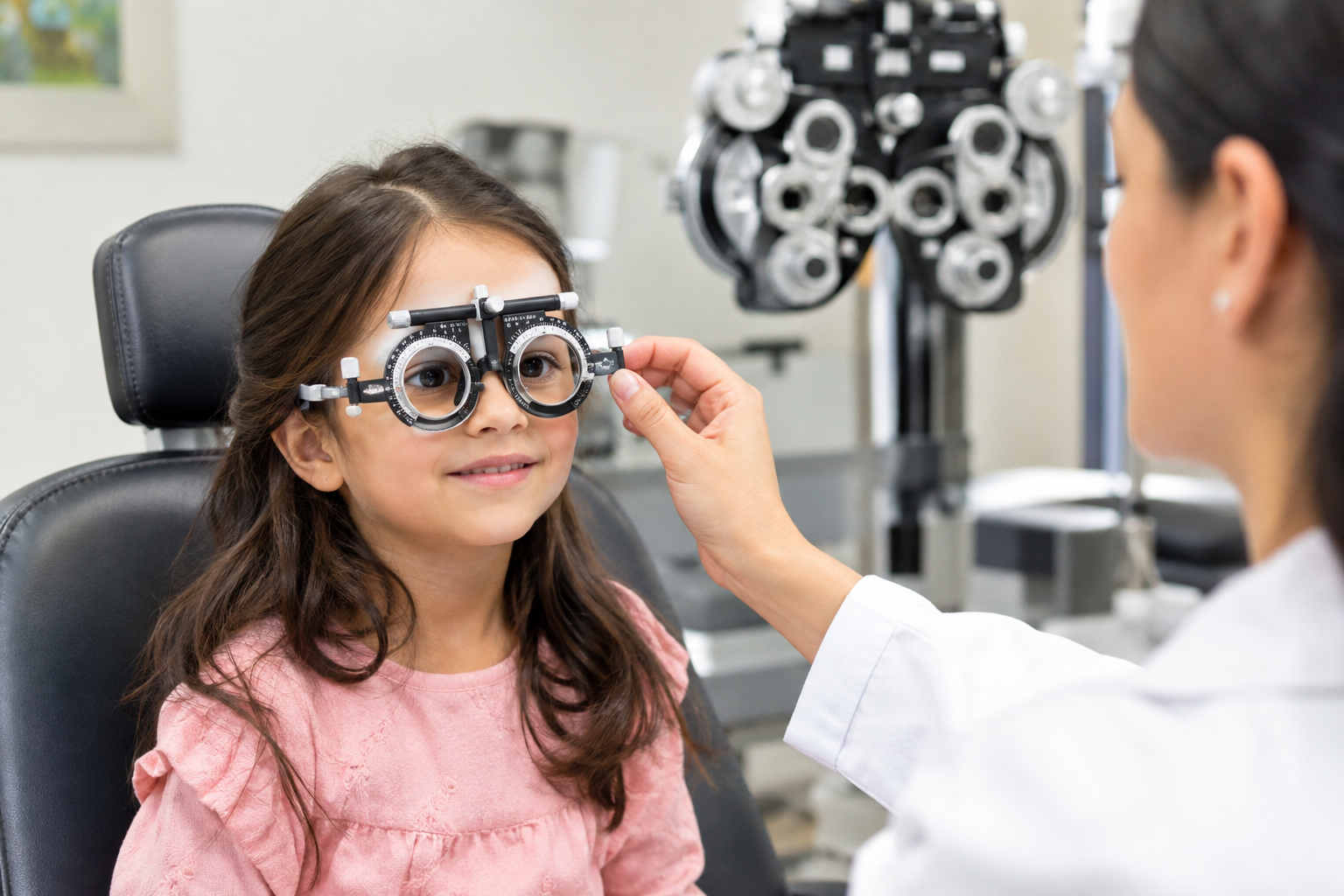
Quick Answer: Children’s vision should be checked regularly, starting in infancy and continuing throughout the school years. Routine vision screening can identify problems that children may not recognize or report. The USPSTF recommends screening at least once between ages 3 and 5, while AAPOS recommends repeat screening every one to two years after age 5. Watch for squinting, headaches, covering one eye, sitting close to screens, reading difficulties, or eye misalignment. Failed screenings or concerning symptoms may require a comprehensive eye exam.
As a parent, you may assume that your child can see well if they can read, play, watch television, and move around without bumping into things.
But children do not always realize that their vision is different from normal.
A child may simply think that everyone sees the world the same way they do. This is one reason routine child vision screening is so important. Vision problems can sometimes be present without obvious symptoms, and finding them early can make a meaningful difference in a child’s development and learning.
As a board-certified pediatrician with more than two decades of experience caring for infants, children, and adolescents, I regularly discuss vision with parents during routine pediatric visits.
This guide explains when your child’s vision should be checked, what warning signs to watch for, and when a child needs a more complete eye examination.
Why Is Vision Screening Important for Children?
Good vision plays an important role in childhood development.
Children use their eyes to learn, read, write, play sports, recognize faces, and interact with the world around them. The CDC notes that an uncorrected vision problem can sometimes interfere with learning and a child’s ability to reach their full potential.
Some vision problems are easy to notice.
Others are not.
A child may not complain about blurry vision because they have never experienced anything different. They may simply adjust by sitting closer to the television, holding books near their face, or relying more heavily on one eye.
Routine screening gives healthcare providers an opportunity to look for potential problems before they become more difficult to manage.
What Is Child Vision Screening?
Vision screening is different from a complete eye examination.
A screening is designed to identify children who may have a vision problem and need further evaluation. It can be performed by trained healthcare professionals, including pediatricians, and may also occur through schools or community programs.
Depending on the child’s age, screening may include:
- Checking visual acuity
- Looking at how the eyes move
- Checking whether the eyes are properly aligned
- Examining the pupils
- Checking the red reflex
- Using an instrument or photoscreening device
- Asking about family history and vision concerns
A screening does not necessarily diagnose a specific eye condition.
If a child does not pass a screening, we may recommend an evaluation by an optometrist or ophthalmologist for a more detailed examination.
When Should a Baby’s Vision Be Checked?
Vision assessment begins very early in life.
During infancy, pediatricians look at the eyes and assess important parts of visual development. This can include checking the red reflex, pupils, eye movement, and how the infant’s eyes appear and function.
Parents should pay attention to whether their baby appears to track objects as expected.
For example, the American Association for Pediatric Ophthalmology and Strabismus (AAPOS) notes that an infant who is not tracking well after about 3 months, has an abnormal appearance of the eye, or has an unusual red reflex should be evaluated promptly.
Other concerns worth discussing with your pediatrician include:
- Persistent eye crossing
- Eyes that do not move together
- A drooping eyelid
- Persistent tearing or discharge
- Unusual appearance of the pupil
- A family history of serious childhood eye disease
Parents do not need to diagnose a problem themselves.
If something about your baby’s eyes looks unusual, bring it to your pediatrician’s attention.
Vision Screening During the Toddler Years
Toddlers are still developing their ability to communicate what they see.
That makes traditional eye-chart testing more difficult.
Depending on the child’s age and ability to cooperate, healthcare providers may use different screening methods. Instrument-based screening, including photoscreening, can help identify certain focusing problems and risk factors for amblyopia in young children.
Amblyopia, sometimes called “lazy eye,” occurs when normal vision does not develop properly in one or both eyes.
Early detection matters because treatment is generally easier when problems with visual development are identified at a younger age.
What About Preschool Children?
The preschool years are especially important for vision screening.
The U.S. Preventive Services Task Force (USPSTF) recommends that children ages 3 to 5 receive vision screening at least once to identify amblyopia or its risk factors.
The American Association for Pediatric Ophthalmology and Strabismus also provides age-specific screening guidance. For children between 3 and 5 years, screening can include visual acuity testing or photoscreening, depending on the child’s age and ability to participate.
At this age, parents may notice signs such as:
- Squinting
- Sitting very close to the television
- Holding books unusually close
- Covering one eye
- Frequent eye rubbing
- Difficulty recognizing things from a distance
- Avoiding activities that require visual concentration
These signs do not automatically mean your child has a vision disorder.
They do mean it is worth discussing the concern with your child’s healthcare provider.
How Often Should School-Age Children Have Their Vision Checked?
Vision screening continues after preschool.
AAPOS recommends vision assessment for children age 5 and older, with repeat screening every one to two years after age 5. Children who cannot meet age-appropriate visual acuity thresholds or who have other concerns may need referral for a comprehensive eye examination.
Vision can change as children grow.
A child who passed a screening last year may develop a problem later. That is why vision should remain part of routine preventive care rather than being treated as a one-time test.
Warning Signs Parents Should Not Ignore
Children do not always tell parents when something is wrong with their vision.
Sometimes the clues appear in their behavior.
I encourage parents to watch for changes such as:
1. Frequent Squinting
Squinting may be a child’s attempt to see something more clearly.
2. Sitting Too Close to Screens
If your child consistently moves very close to the television, computer, or tablet, mention it during a pediatric visit.
3. Headaches During Reading
Repeated headaches after reading, homework, or other visually demanding activities may deserve evaluation.
4. Covering One Eye
A child who frequently closes or covers one eye may be experiencing difficulty using both eyes together.
5. Trouble at School
Vision problems can sometimes affect reading, copying from a board, or completing visually demanding assignments. This does not mean every learning difficulty is caused by poor vision, but it is reasonable to make sure vision is not contributing.
6. An Eye That Turns or Wanders
Persistent eye misalignment should be evaluated rather than assumed to be something a child will simply outgrow.
7. Sudden Changes in Vision
Sudden vision loss, significant changes in vision, severe eye pain, or an eye injury requires prompt medical attention.
Screening Is Not the Same as a Comprehensive Eye Exam
This distinction is important.
A pediatric vision screening looks for signs that a child may need additional eye care. A comprehensive examination by an eye-care professional is more detailed and can diagnose and manage specific eye conditions.
Not every child who passes routine screening needs a comprehensive eye examination every year.
Routine screening can identify many significant problems in otherwise asymptomatic children, and children who fail screening should receive appropriate follow-up.
Children with known eye conditions, certain medical conditions, significant family history, or other risk factors may need a different schedule.
Your child’s healthcare provider can help determine what is appropriate.
When Should Parents Arrange a Vision Evaluation?
Contact your pediatrician or schedule a comprehensive eye exam if your child demonstrates:
- Squinting, tilting their head, or closing one eye to focus
- Holding books or screens closer than 8 to 10 inches from their face
- Frequent eye rubbing, excessive tearing, or light sensitivity (photophobia)
- Frequent headaches or eye fatigue after school or reading
- An eye that turns inward, outward, upward, or downward after 4 months of age
- A white or cloudy spot inside the pupil (Leukocoria)
A child should also receive follow-up if they do not pass a routine vision screening.
If your child experiences sudden vision loss, severe eye pain, significant eye injury, or another urgent eye problem, seek prompt medical care rather than waiting for a routine appointment.
How Parents Can Support Healthy Vision
Parents can support their child’s eye health by keeping routine pediatric appointments and paying attention to changes in behavior or school performance.
It is also helpful to:
- Encourage regular breaks during prolonged near work or screen use
- Make sure children have adequate lighting for reading
- Encourage outdoor play and physical activity
- Use appropriate protective eyewear for certain sports and activities
- Follow recommendations from your pediatrician or eye-care professional
- Keep recommended vision screenings up to date
Most importantly, do not assume that no complaint means no problem.
Vision Screening at Gentle Pediatrics
Routine vision screening is an important part of preventive pediatric care.
At Gentle Pediatrics, we believe children’s health involves much more than treating illness when symptoms appear. Preventive visits give us an opportunity to monitor growth, development, learning, behavior, hearing, vision, and other important areas of health.
As a child doctor in Sugar Land, I encourage parents to bring up even small concerns. Sometimes a simple question can lead to an important evaluation.
About Dr. Shahid Hasnain
I am Dr. Shahid Hasnain, a board-certified pediatrician with more than two decades of experience caring for infants, children, and adolescents.
My professional training includes a Master of Public Health specializing in Maternal and Child Health, pediatric internship training at Lincoln Hospital in New York, and pediatric residency training at the University of Tennessee Medical Center in Knoxville, where I served as Chief Resident during my final year.
I have been board certified by the American Board of Pediatrics since 1998.
Throughout my career, I have focused on providing evidence-based medical care while communicating with families in a clear, patient, and compassionate way.
Final Thoughts
Parents do not need to wait until a child complains about blurry vision before thinking about eye health.
Vision screening should be part of routine childhood care, beginning in infancy and continuing through the school years. Screening recommendations vary by age, and children with specific concerns or risk factors may need additional evaluation.
The good news is that many childhood vision problems can be identified through routine screening.
If you notice changes in your child’s vision, reading habits, school performance, or eye appearance, bring them up with your pediatrician.
A few minutes of screening can sometimes provide information that a child may not know how to explain.
Schedule a Pediatric Visit
If you have concerns about your child’s vision or need routine preventive care, our team at Gentle Pediatrics is here to help.
Gentle Pediatrics proudly serves families throughout:
- Sugar Land
- Richmond
- Rosenberg
- Stafford
- Katy
- Houston
Gentle Pediatrics — Sugar Land, Texas
Contact our office today or fill out the online patient registration form to schedule an appointment and discuss your child’s vision, development, and overall health.
Frequently Asked Questions
1. At what age should my child have their vision checked?
Vision assessment begins during infancy. Children should continue to receive age-appropriate screening throughout childhood. The USPSTF recommends vision screening at least once for children ages 3 to 5.
2. What is the difference between vision screening and an eye exam?
Vision screening looks for signs that a child may have a vision problem. A comprehensive eye exam performed by an eye-care professional provides a more detailed evaluation and can diagnose specific eye conditions.
3. How often should school-age children have vision screening?
AAPOS recommends repeating vision screening every one to two years after age 5, although individual recommendations may differ based on a child’s health and risk factors.
4. What signs may indicate a vision problem?
Squinting, covering one eye, frequent headaches during visual tasks, difficulty reading, sitting unusually close to screens, or an eye that turns or wanders can be reasons to discuss vision with your child’s healthcare provider.
5. Does my child need a comprehensive eye exam if they pass screening?
Not necessarily. Children who pass routine screening may not need annual comprehensive eye exams unless they have symptoms, risk factors, known eye conditions, or another reason for specialist evaluation.
This article is intended for educational and informational purposes only and should not be considered medical advice, diagnosis, or treatment. Every child’s health needs are unique. Always consult your pediatrician, optometrist, ophthalmologist, or other qualified healthcare professional regarding concerns about your child’s vision or eye health.